Wiz: intent IDs from attack harnesses leak into victim logs
Wiz reports that agentic attack harnesses number their sub-goals and leave those intent IDs behind in a victim's own logs.
· Wiz Research · Research by Rami McCarthy, Hila Ramati

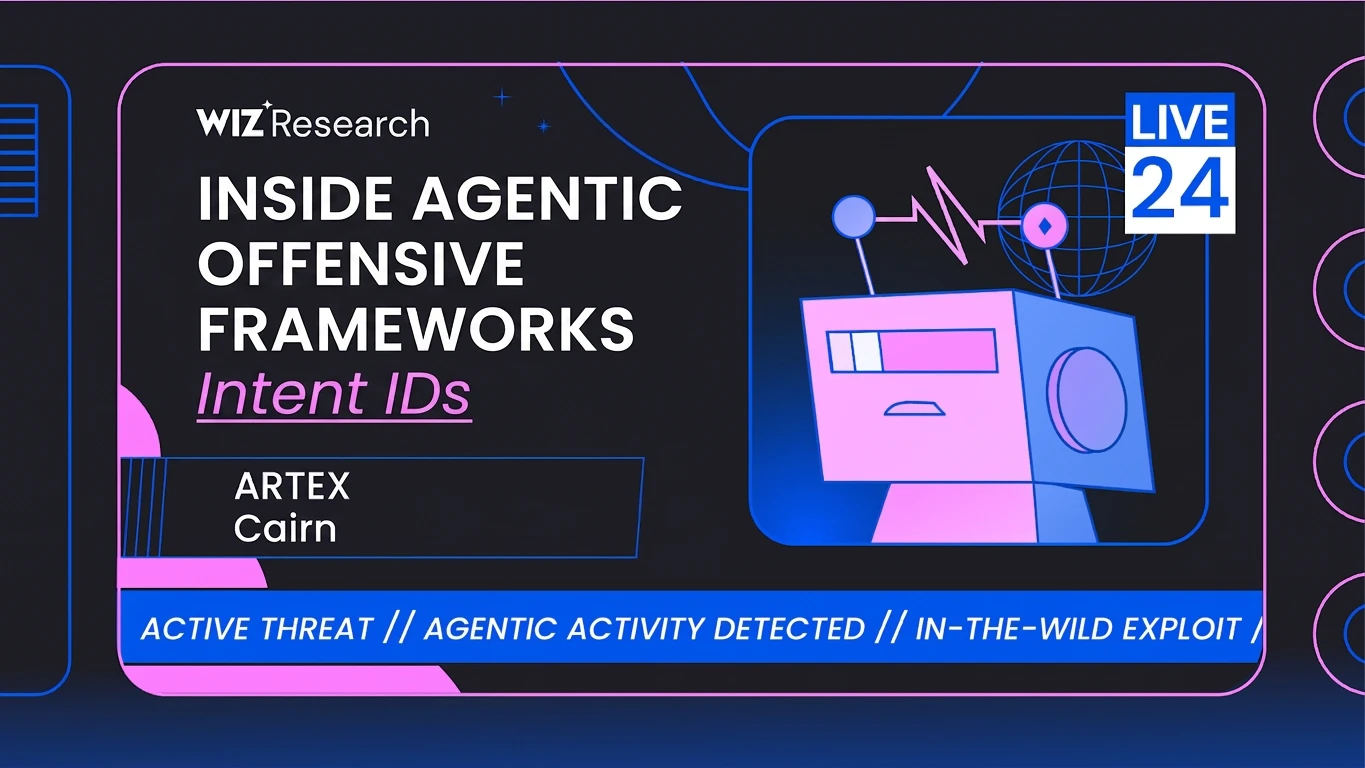
Agentic attack harnesses number their sub-goals, and Wiz reports those intent IDs surviving in AWS role session names, SSM command comments, Azure run-command names and file paths. The highest Wiz has seen is i808807.
01What happened
Wiz researchers Rami McCarthy and Hila Ramati published the finding on November 25, 2026, after reviewing more than 100 open-source offensive harness repositories and 539 ARTEX worker transcripts covering about 10,900 shell commands. They describe intent IDs, short identifiers of the form iNNNN, as a new kind of harness leak. Examples from the activity Wiz calls Black October include i19ghci.yml at Barracuda and artex-i37257 at Chainstack.
02How it works
A harness splits an intrusion into numbered sub-goals it calls intents, then puts the intent ID into prompts and workspace paths. The model reuses the string when it names files, accounts, workflows and user-agent values, so the ID lands in the target's own logs. ARTEX draws intents from a single PostgreSQL BIGSERIAL sequence that does not reset by default, so its numbers climb across runs and targets. Cairn instead uses a zero-padded counter per object type that restarts for each project, which keeps its numbers small and gapless.
03Who is affected
Wiz names ARTEX, the ARTEX forks Pojun and AntiFox, Cairn, and the Cairn reimplementation sapper-v2. Defenders running cloud workloads can look for the IDs in AWS role session names, SSM command comments, bucket, role, user and policy names, tags, RDS export task IDs and KMS key aliases, and in Azure run-command names, VM computer names and app registration names. Wiz notes the names can also survive in error messages for calls that were denied.
04What to do
Pair an i<N> string with an anchor such as artex-, pentest-, probe or canary, or with a leaked run path like tasks/<task>/i<N>, before alerting, because Wiz says the IDs are noisy on their own. Wiz also cautions that the signals are corroborative, not standalone attribution: work against other targets advances the counter, fresh installations share number ranges, and an operator can reset or parallelize the sequence.
Sources 2 links, all fetched
- 1wiz.ioWiz Research
- 2wiz.ioWiz Field Report