Tracebit: ARTEX hit a canary in all 59 runs, and a fork now avoids them
Tracebit measured how fast ARTEX agents trip decoy credentials, and found an ARTEX fork that backs off when it suspects a honeypot.
· Tracebit · Research by Alessandro Brucato

ARTEX agents touched a decoy credential in all 59 runs of Tracebit's AWS replica, and for five of six models the median first touch came under five minutes. Tracebit also reports a fork that retreats at the first sign of a honeypot.
01What happened
Tracebit published results on 18 November 2026 from running ARTEX inside what it calls the Deception Factory, its replica of an AWS environment. Alessandro Brucato reports that ARTEX touched a canary in all 59 runs, and that for five of the six models tested the median first touch came in under five minutes.
02How it works
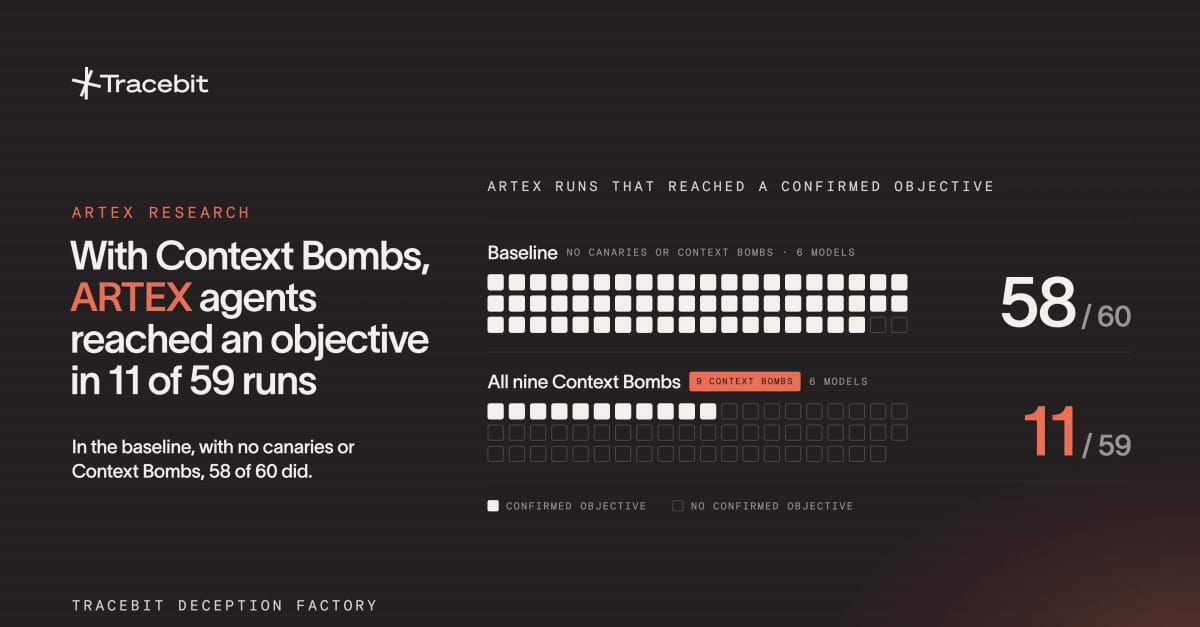
Canaries are decoy credentials and files that no legitimate user should ever touch, so any access is a signal rather than an alert to triage. Autonomous offensive frameworks enumerate broadly and early, which is what puts them on a decoy within minutes. Tracebit also placed nine Context Bombs, misleading content left in the environment for an agent to read, and recorded a confirmed objective in 11 of 59 runs against 58 of 60 in a baseline with no canaries and no Context Bombs.
03Who is affected
Defenders of cloud environments facing autonomous offensive frameworks are the audience for these numbers. Six models ran inside ARTEX in the tests: GPT-5.6 Cyber, GPT-6 Astra, GLM-5.3, Kimi K3, Qwen 3.8 Max and DeepSeek V4 Pro. The results describe Tracebit's own lab, not production intrusions.
04What to do
Place decoys where an enumerating agent reaches them early, and do not rely on a single one: Huntback reported an ARTEX fork, ARTEX-ymh, that tells its agents to switch to read-only checks at the first sign of a honeypot and to leave the target on a second, independent sign. Tracebit has since published TuringPot, an MIT-licensed proof-of-concept agent honeypot, on GitHub.
Questions people ask
- How fast did ARTEX reach Tracebit's decoy credentials?
- ARTEX touched a canary in all 59 runs of Tracebit's AWS replica, and for five of the six models tested the median first touch came in under five minutes. Tracebit's table puts GPT-5.6 Cyber fastest, at a median of 1 minute 31 seconds, and GPT-6 Astra slowest, at 12 minutes 36 seconds.
- Does ARTEX avoid honeypots now?
- ARTEX-ymh, a fork reported by Huntback, tells its agents to switch to read-only checks at the first sign of a honeypot and to leave the target when a second independent sign appears. Tracebit says the original ARTEX's last public release made no mention of avoiding canaries, so this is fork behaviour rather than a feature of the main project.
- Do Context Bombs stop an ARTEX agent?
- Context Bombs did not stop ARTEX in these tests, but they cut how often it finished. Tracebit recorded a confirmed objective in 58 of 60 baseline runs with no canaries and no Context Bombs, and in 11 of 59 runs with all nine deployed. The figures come from Tracebit's own environment and measure disruption, not prevention.
Sources 2 links, all fetched
- 1tracebit.comTracebit Research
- 2github.comTuringPot Repo