Mirror Dimension: Chrome tests browsing agents on a fake web
Google's Chrome AI Security team evaluates browsing agents on thousands of generated sites instead of the live web.
· Google · Research by Aaron Selya, Charles Qian

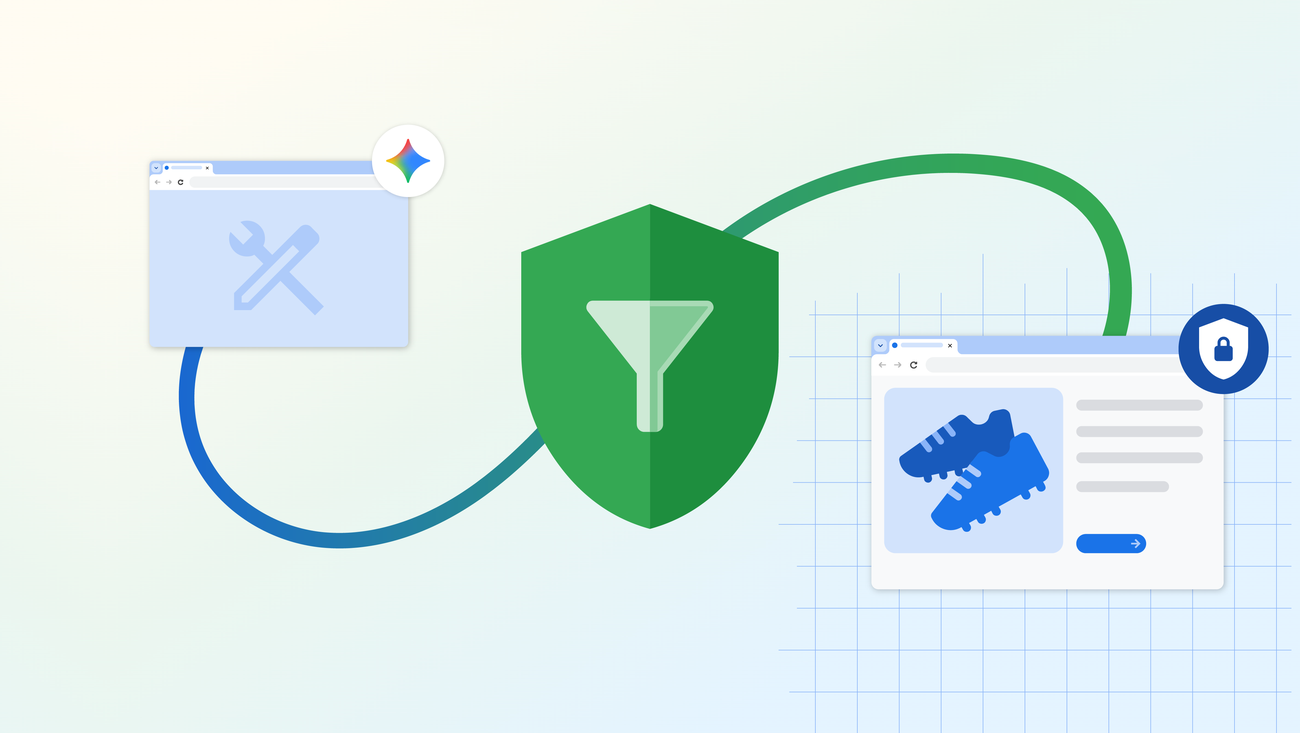
Mirror Dimension is a sealed synthetic web that Chrome's AI Security team uses to test browsing agents against indirect prompt injection. Google says the pipeline writes more than 1,000 attack test candidates per engineer per day.
01What happened
Aaron Selya and Charles Qian, software engineers on Chrome AI Security, described Mirror Dimension on Google's security blog on 19 November 2026. The post sets out how Google builds the environment and how it generates attacks for Chrome's auto browse feature. Google publishes no figures for how often the agent resists those attacks.
02How it works
Headless Chrome runs inside a gVisor sandbox, and a local interception proxy serves generated pages under real URLs instead of reaching external DNS. The proxy mints TLS leaf certificates that chain to a custom root CA pre-installed in that Chrome, so no certificate warning appears. A research agent writes the site specification, a builder agent writes the HTML, CSS and JavaScript, and critic agents check the result through Chrome DevTools MCP. Which injection payload a page serves is selected by an HTTP header that the server strips before responding, so the visible URL never changes.
03Who is affected
Mirror Dimension is internal Google testing infrastructure, not a Chrome setting a user can turn on. Its scope today is browser-use agents with bounded web primitives and tool calls. Google describes extending the design to general-purpose coding agents as a belief rather than a demonstrated result.
04What to do
Teams that red-team their own browsing agents can copy Google's reported fix for eval awareness: keep attack markers out of the visible URL and pass them in a header the server removes before it serves the page.
Questions people ask
- Can anyone outside Google use Mirror Dimension?
- Mirror Dimension is internal Chrome testing infrastructure, not a product or a browser mode. Google's post describes the architecture and the generation pipeline but offers no download, no public endpoint and no open-source release. Readers outside Google can reuse the design ideas, in particular the interception proxy serving real URLs and the header-selected payloads, but not the environment itself.
- Does the post show that Chrome's agent resists prompt injection?
- Google reports no pass rates, no vulnerability counts and no measured reduction in attack success, so the post is about testing capacity rather than measured robustness. Google states that the environment is a critical tool for making new capabilities safe and resistant to threats, which is the company's claim about its own process, not an independent result a reader can check.
- Why does Google serve test pages under real URLs such as youtube.com?
- Google found that a visible sandbox domain made the test feel artificial and induced eval awareness, where the model recognises it is being evaluated and behaves differently. Serving generated pages under real URLs keeps that signal out of the agent's view. The same reasoning led Google to move attack markers out of URL parameters and into an HTTP header the server strips.
Sources 2 links, all fetched
- 1blog.googleGoogle Security Blog
- 2github.comChrome DevTools MCP