wfx-loot: an npm hook runs the CI secret stealer GitHub's holds missed
wfx-loot pushes a secret stealer into public repositories, and its npm hook version runs even where GitHub held the workflow version.
· GitGuardian · Research by Gaetan Ferry

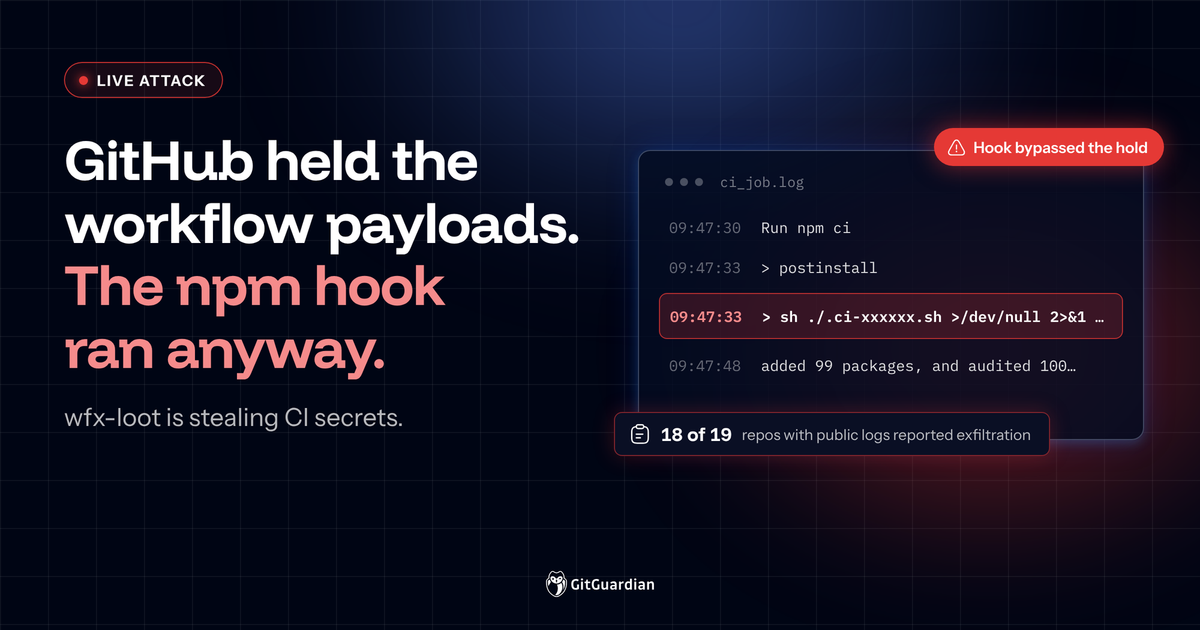
wfx-loot is a credential-theft campaign that pushes a CI secret stealer into public repositories with stolen GitHub credentials. GitGuardian counted 28,500 payload patches from 2,367 accounts across 17,715 repositories.
01What happened
GitGuardian published research on November 13, 2026 into wfx-loot, a campaign that commits a CI secret stealer to public GitHub repositories using stolen credentials. Security researcher Gaetan Ferry traced a small precursor between October 24 and 29, then a mass wave that began on November 10 and was still running on November 12. The dataset holds 28,500 payload patches from 2,367 accounts across 17,715 repositories.
02How it works
The payload ships in four wrappers: a throwaway workflow on a side branch, a step added to an existing workflow, a hidden root script called by an npm lifecycle script such as postinstall, and code appended to a shell script a workflow already calls. GitHub placed the workflow-file versions in action_required, so those runs were held. The npm hook changes no workflow file, so a repository's existing workflows execute the script during dependency installation. Once running, it collects repository and organization secrets, environment variables, credential files, runner memory and cloud credentials, and can use OIDC tokens to mint new cloud access.
03Who is affected
Organizations whose GitHub credentials were stolen, and whose workflows install dependencies without the ignore-scripts flag, are exposed. GitGuardian reports the payload matches about 90 AI provider environment-variable prefixes, among them OpenAI, Anthropic, Gemini, Bedrock, Hugging Face, Mistral, OpenRouter and Cursor, and that it reads credential files for the seven AI coding tools listed below.
04What to do
Check whether the payload ran: look for npm, pnpm or yarn installs on the hook commit that ran without the ignore-scripts flag, and search job logs for the script name. Rotate every repository and organization secret and variable reachable from an affected job, not only the ones the workflow used. Revoke the compromised account's personal access tokens, OAuth and GitHub App grants, and SSH keys.
Questions people ask
- Did GitHub's hold on wfx-loot workflows stop the attack?
- GitHub placed the workflow-file versions of wfx-loot in action_required, so those runs were held and did not execute. GitGuardian reports the npm lifecycle hook version changed no workflow file, so a repository's existing workflows ran the hidden script during dependency installation. Hook commits on default branches rose to 838 on November 11 and 1,210 on November 12, after the holds.
- Which AI credentials does wfx-loot steal?
- wfx-loot matches about 90 AI provider environment-variable prefixes, including OpenAI, Anthropic, Gemini, Bedrock, Hugging Face, Mistral, OpenRouter and Cursor. GitGuardian reports the payload also reads credential files for seven AI coding tools: Claude Code, Codex, Gemini CLI, Cursor, GitHub Copilot, Aider and Ollama. Repository and organization secrets, runner memory and cloud credentials are collected alongside them.
- How do I tell whether wfx-loot ran in my repository?
- GitGuardian advises checking for npm, pnpm or yarn installs on the hook commit that ran without the ignore-scripts flag, and searching job logs for the script name. Reviewing the organization audit log for approved and executed workflow runs is the second check. Developer machines that installed dependencies during the affected window should be examined too.
- Is wfx-loot the same campaign as GhostAction?
- GitGuardian found that 431 accounts, about 20% of those used in the wfx campaign, had already been compromised in the earlier GhostAction wave, and notes the overlap does not prove a single actor. GhostAction, which GitGuardian disclosed in September 2025, stole 3,325 secrets from 327 accounts across 817 repositories through malicious GitHub workflows.
Sources 2 links, all fetched
- 1blog.gitguardian.comGitGuardian Research
- 2blog.gitguardian.comGhostAction Campaign